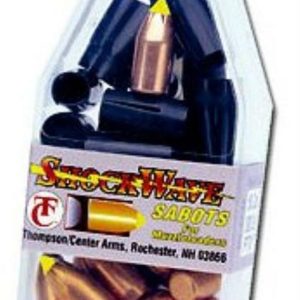
Description
Let me tell you about a day at the range that changed my mind on muzzleloader sabots. I was working up a load for my Thompson Center Encore, trying to find that sweet spot between power and consistency. I’d tried a few different sabots with mixed results—some were finicky, others just didn’t group well. Then I grabbed a pack of the Thompson Center Sabot Shockwave .50 Caliber 300Gr, 15rds. After putting a dozen rounds downrange, the difference was clear. This isn’t just another projectile; it’s a purpose-built system designed to deliver modern ballistic performance from a traditional platform. For the hunter or shooter who demands precision from their front-stuffer, this is the component that bridges the gap.
So, what exactly are you getting? The Shockwave sabot is a 300-grain, .50 caliber polymer-tipped bullet housed in a high-performance sabot. The design is all about reliable expansion and deep penetration, making it a top contender for medium to large game. The polymer tip initiates rapid, controlled expansion, while the thick jacket and bonded core are engineered to retain weight and drive deep. I’ve found they load smoothly and consistently, which is half the battle when you’re in the field with cold fingers. At $17.52 for a pack of 15, you’re looking at a cost-effective way to significantly upgrade your muzzleloader’s terminal performance without breaking the bank.
Key Features & Performance
The first thing you’ll notice is the build quality. The sleek, polymer-tipped design isn’t just for looks—it aids in ballistic coefficient and ensures reliable feeding from your bullet starter. I’ve loaded these into several Thompson Center rifles, including the Triumph and Encore, and they fit out of the box with no fuss. The sabot itself is precisely engineered for a consistent gas seal, which translates directly to more uniform velocities and better groups on paper. That consistency is what you pay for.
On the range, the 300-grain weight offers a great balance. It’s heavy enough to carry kinetic energy for ethical takedowns, yet not so heavy that it becomes a punishing recoil monster or suffers from a rainbow trajectory. I’ve chronographed these over 100 grains of Blackhorn 209 powder, and they hold a tight velocity spread. The real test, of course, is on game. The bonded core construction is the key here—it’s designed to prevent fragmentation, so you get a large, permanent wound channel and an exit wound for a good blood trail. It’s a system that inspires confidence when that buck steps into your lane.
| Specification | Detail |
|---|---|
| Caliber | .50 Caliber |
| Bullet Weight | 300 Grains |
| Quantity per Pack | 15 Rounds |
| Bullet Type | Polymer-Tipped, Bonded Core |
| Purpose | Muzzleloader Hunting / Target |
| Compatibility | Designed for .50cal muzzleloaders using sabots |
The Good: Excellent bonded-core expansion and weight retention. The polymer tip aids accuracy and reliable performance. The sabot provides a consistent seal for improved shot-to-shot uniformity. Priced right for the performance you get. Works seamlessly in Thompson Center and other quality .50 caliber rifles like CVA.
The Consideration: As with any sabot, optimal performance depends on matching it to your rifle’s barrel twist rate and preferred powder charge. You’ll want to test a few loads to find your rifle’s favorite. They are a hunting projectile first, so if you’re solely punching paper at 100 yards, a cheaper, non-bonded option might suffice.
Who This Is For
This is for the muzzleloader hunter who has moved past the basics. You understand that the projectile is the single most important factor in a clean harvest. You’re likely hunting whitetail, mule deer, or even black bear in Missouri’s dense woods or open fields, and you need a bullet that will perform at various ranges and on quartering shots. It’s also for the shooter who appreciates the simplicity of a system that works—load, shoot, clean—with proven results. This product is available at firearms-missouri.com for Missouri residents and nationwide, so sourcing it is straightforward.
Frequently Asked Questions
Q: What powder charge is recommended for these sabots?
A: Always consult your rifle’s manual first. That said, I’ve had great results with 90 to 110 grains by volume of Blackhorn 209, Pyrodex, or equivalent pellets in my T/C. Start at the manufacturer’s recommended minimum and work up your load safely.
Q: Are these compatible with my inline muzzleloader?
A: Yes, if your rifle is a .50 caliber designed to use sabots (most modern inlines are). They are a perfect match for Thompson Center rifles like the Encore, Triumph, and Compass, and also run well in CVA Wolf or Optima models. Remember, an FFL transfer is required for firearm purchases, but these components ship directly.
Q: How is the accuracy at longer ranges?
A: The streamlined design and bonded core make them surprisingly capable out to 200 yards and beyond in a capable rifle. The key, as always, is finding the right powder charge for your specific gun. I’ve consistently achieved sub-2″ groups at 100 yards with a tuned load—more than enough for most hunting scenarios.
If you’re ready to see what your muzzleloader can really do, grab a pack of these Shockwaves and hit the bench. See the difference for yourself.
Reviews
There are no reviews yet.